Trip Report: Inclusive Design Campout with NEMO Equipment

This post contains affiliate links. When you purchase something using one of these links, I get a small commission of that purchase (from the retailer, not you!) which lets me keep making content like this! To learn more about my use of affiliate links, please click here.

An Adventure with NEMO’s Product Design Team and Central Maine Adaptive Sports

If you’re familiar with my work, you know that I focus on making the outdoor industry, specifically the bike world, more accessible to fat people. My vision, however, is a world where all outdoors equipment is accessible to people of all sizes and shapes. 

If you’re fat and have tried to go backpacking or bikepacking, you know the problem. Lightweight, backcountry gear is not made for big people. Sleeping bags and pads are too narrow, camp furniture doesn’t hold our weight, and often the backpacks don’t fit us. The gear that does work for us is often too big or bulky to reasonably stuff down for a backpacking or bikepacking trip. 

Which leads me to the Inclusive Design Camping Trip I got to go on last weekend with NEMO Equipment and Central Maine Adaptive Sports. There might be hope you guys!!

New friends from Central Maine Adaptive Sports

New friends from Central Maine Adaptive Sports

Let me back up a minute.   One of the first brands I worked with on size inclusive design was NEMO Equipment. In February, I was invited to be on an Inclusive Design Panel with a few other folks, including Christy Gardner, a Special Olympics Coach, and a few other athletes/outdoors people. 

On that panel with the NEMO Product team, we each shared our experience as non-traditional outdoors people and the challenges we encounter with standard camping equipment. I specifically detailed my frustration with camp furniture weight limits typically being pretty low, not having enough room in my sleeping bag, and the length of tent poles for bikepacking. Christy and the other athletes shared their experiences, including getting into/out of a tent in a wheelchair, struggling with zippers with using prosthesis and missing limbs, and other challenges.


Even though this panel was virtual, the product team had so many great questions and ideas for improvements that could potentially be made and seemed genuinely excited to improve on their designs to make them more accessible to wider audience. At the end of the panel, we jokingly discussed getting together once it was safe to do so for a real camping trip…and what do you know, it actually happened!

Setting up camp with the Product Design Team

Setting up camp with the Product Design Team

We camped at Christy’s brand new house, built for her by A Soldier’s Journey Home

Christy is the Board President for Central Maine Adaptive Sports and was an Army Sergeant in Korea when she was severely injured during a foot patrol, leaving her with severe injuries that have resulted in a double amputation, a spinal cord injury, and other lasting injuries. 

Christy’s pack of eight dogs! Two of them are hers - she’s training the other six to be Service Dogs

Christy’s pack of eight dogs! Two of them are hers - she’s training the other six to be Service Dogs

She’s a powerhouse of good-she’s a professional athlete, she founded Mission Working Dogs and is currently living with 8 dogs, six of them service dogs in training at her house! I was exhausted just watching her in action! 

Ok- sorry for all the gushing. But seriously - you know when you meet someone who is making changes in the world and you just want to support everything they’re doing? That’s how I feel about the work Christy is doing. I’m really excited I met her and really hope we can do some work together in the future - especially around adaptive cycling! 

So this camping trip! HOLY MOLEY! What a treat!

First off - Maine is absolutely stunning! I don’t know if it’s normal to have 70 degree weather in October, but I’ll take it. The night was cold, but I was nice and toasty with a campfire and 15 degree sleeping bag


To give the product team the best insight, they were split up among participants for camp setup. I was tasked with setting up the Aurora Backpacking Tent, the Quasar 3D Sleeping Pad, the Women’s Disco 15 Degree Bag and the Stargaze Recliner Luxury Chair (which is definitely going on my wish list.) On my “team” to help out was Cam, the CEO, and Mark, a Product Designer. I have to tell you, it was a bit embarrassing to admit to them that I don’t read instructions on tents, but they wanted to watch my actual process. So I gave them the truth! 

After camp setup, we enjoyed a dinner together, campfire and s’mores and lots of dog snuggles. Christy brought out a few of her wheelchairs for the team to test out, which was surprisingly fun, especially the chair she uses in the snow. I retired pretty early and actually had a really cozy night’s sleep - and the sleeping bag fit!! I could fully zip the whole bag up around my body with my arms inside the bag with room to spare! 

After breakfast the next morning, we did a debrief around the fire, sharing our experiences with the equipment. We each shared one thing we were delighted with, one thing we were surprised by, and one thing we were frustrated by. It was super cool to hear everyone’s experiences and you could see the product team taking notes in their head for ideas to take back to the office.

From there, we broke down camp and cleaned up, leaving Christy’s backyard once again to the dogs. I caught a ride into Boston, where I had an All Bodies on Bikeside planned for the next day! 


Overall, it truly felt like the NEMO product team actually paid attention to our feedback and cared about our experiences and really wanted to learn from the trip. From the engineers to the designers, they all had thoughtful questions and genuinely got to know us.

Debriefing our experiences around the campfire

Debriefing our experiences around the campfire

Honestly, I’m so appreciative for the time, effort, and money that was put into this trip. Perhaps most refreshing of all - there wasn’t a photographer or media person on the trip. There was no live tweeting or updating NEMO’s stories about this. I don’t think there’s even a mention of this on any of their social media. In fact, I had to get permission to write this blog - NEMO is not doing inclusive design just for the likes. They’re doing it because it’s the right thing to do.


But they’re also not promising anything yet, in terms of new products, which I honestly appreciate.  We all know how businesses work - priorities can change in an instant, things get put to the chopping block and supply chains can disrupt everything. 

While we’re not at a fully inclusive outdoor world yet, trips like this are a great step in that direction. Thanks for including me in this effort NEMO and I’m so excited for this more inclusive world we’re creating together! 

IMG_6444.jpg

The Best Bike Seat for Heavy Riders - Updated July 2024

The Best Bike Seat for Heavy Riders - Updated July 2024

Looking for a more comfortable seat for your bicycle? I’ve got you covered! From indoor riding to tricycles to long distance touring, I’ve rounded up my favorite saddles for heavier riders in one place. Every saddle listed has a weight limit of 300+ pounds, with a few with a limit of over 600 pounds.

I Did a Cyclocross Race and Came in Dead Last

Lap 1 - already suffering

Lap 1 - already suffering

Last weekend I lined up at my first cyclocross race start line in the Women’s Beginner category, full of nerves, fear and excitement. Aside from half a lap dressed in a Santa suite in Portland a few years ago at the Single Speed World Series, I’ve never attempted cyclocross. For years I’ve stood on the sidelines and cheered on my friends.

I’ve always wanted to get out there and try it. Everyone (literally everyone) who has ever raced cross will tell you “It’s so fun.” “You just race your own race and do your own thing.” “Nobody cares how slow or fast you’re going - they’re all too concerned about their own race.”

Despite this AND all the body positivity and inclusion in cycling work I do, I’ve always been too intimidated to actually get out there myself. I was afraid of the mass start. I was intimidated by the performative aspect of everyone watching and cheering, and the idea that everyone would truly see just how much slower I am than everyone else, and frankly simply feared that I was too fat, too slow, and too unskilled to race cyclocross.

I also didn’t have a bike that would work for cross racing. For those unfamiliar, cyclocross is basically a criterium style race where you take on a variety of terrain and obstacles - from grass to mud to singletrack. An ideal bike is one that you can dismount/remount quickly, pickup easily to run with, and has clearance for knobby tires.

Sure, my Surly Straggler would’ve worked, but I was using that as my do-it-all commuter, touring, city bike, so removing the fenders, racks and accessories was not an option (or at least one that I was willing to do.)

Fast forward to 2021 and I’ve now been blessed with a stable of bicycles which has allowed me to convert my Surly Straggler into a single speed cyclocross bike! (HUGE thanks to competitivecyclist.com - one of my sponsors!

So here’s how the race went, what I learned, and what I’ll do differently next time!

The Surly in all her glory

The Surly in all her glory

Race Prep & Practice

In the weeks leading up to the race, I attended a few practice sessions with a local WTFNB (women trans femme non-binary) club called Breakfast Cycling. At these practices, we ran through a number of drills that would come in handy during the race. These included mounting and dismounting my bike, learning how to turn tight corners, how to carry my bike efficiently up hills, and how to start a race.

These practices were so helpful. If you’re looking into starting cyclocross, I highly recommend finding a team or group that runs practices. I was able to learn in a safe environment, ask questions and make mistakes in a supportive environment without the race day pressures.

What I Packed

Turns out, I took a lot of stuff to the race. Most of the stuff I didn’t end up using, but was glad I had it just in case. I’m sure I’ll get this list dialed in as the season goes on, but here’s what I packed:

Floor Pump

Change of Clothes (for after the race)

Towel (to sit on in my car)

Water Bottles + Nuun (electrolyte tabs)

Chamois Butt’r

Snacks

Camping Chair

Dog Bowl & Leashes

Spare Tubes (even though I’m set up tubeless)

Multitool

Extra Shoes & Socks

The Actual Race

I carpooled to the race with a teammate and we arrived a few hours early to give ourselves time to register and pre-ride the course. I wish I would’ve had more time to pre-ride the course more, as each lap I got more comfortable with tricky sections which would’ve made the actual race easier.

In our local series, all the women’s categories (except single speed) race together. This means total beginners like myself are on the course at the same time as world tour pros like Heidi Franz. Each category starts 30 seconds apart, with the fastest women starting first, and us taking off a few minutes after them.

From the start, I was in the back of the pack (which truthfully, is where I like to be.) I get nervous when other riders are right on my wheels, so riding my own pace at the back was perfect. I definitely started out way too hard and found myself struggling to breathe and heartrate way too high. I unfortunately forgot my heartrate monitor, but I’m looking forward to wearing it for future races.

Around the middle of the first lap, I eventually found my groove and settled into a sustainable pace for the rest of the race. That definitely included stopping for handups (beer, a cookie and some pickles) but hey! Race your own race!

Cyclocross is a funny sport in that I still don’t really understand how/why/when I’m done. I know I got lapped twice by the leader and at the end of the race there was a sign that said “you are done.” So I stopped riding.

Learnings for Next Time

My next race is coming up on Sunday and I’ll again be in the Beginner Women’s field. The only changes I’ll make for this week are to remember my heart rate monitor, eat more food, and maybe put a bit more air in my tires.

All smiles at the finish line

All smiles at the finish line

This blog contains affiliate links. When you make a purchase from one of my links (which I hope you do), I receive a small commission, which helps me keep doing this work. To learn more about my use of affiliate links, please click here.

How to Bike Commute - for regular, everyday people

This blog contains affiliate links. When you make a purchase from one of my links (which I hope you do), I receive a small commission, which helps me keep doing this work. To learn more about my use of affiliate links, please click here.

I’m going to let you in on a little secret - your commute doesn’t have to be a drag! It’s true - you can actually enjoy the time you spend going to and from work, school, or wherever! The secret - go by bicycle!

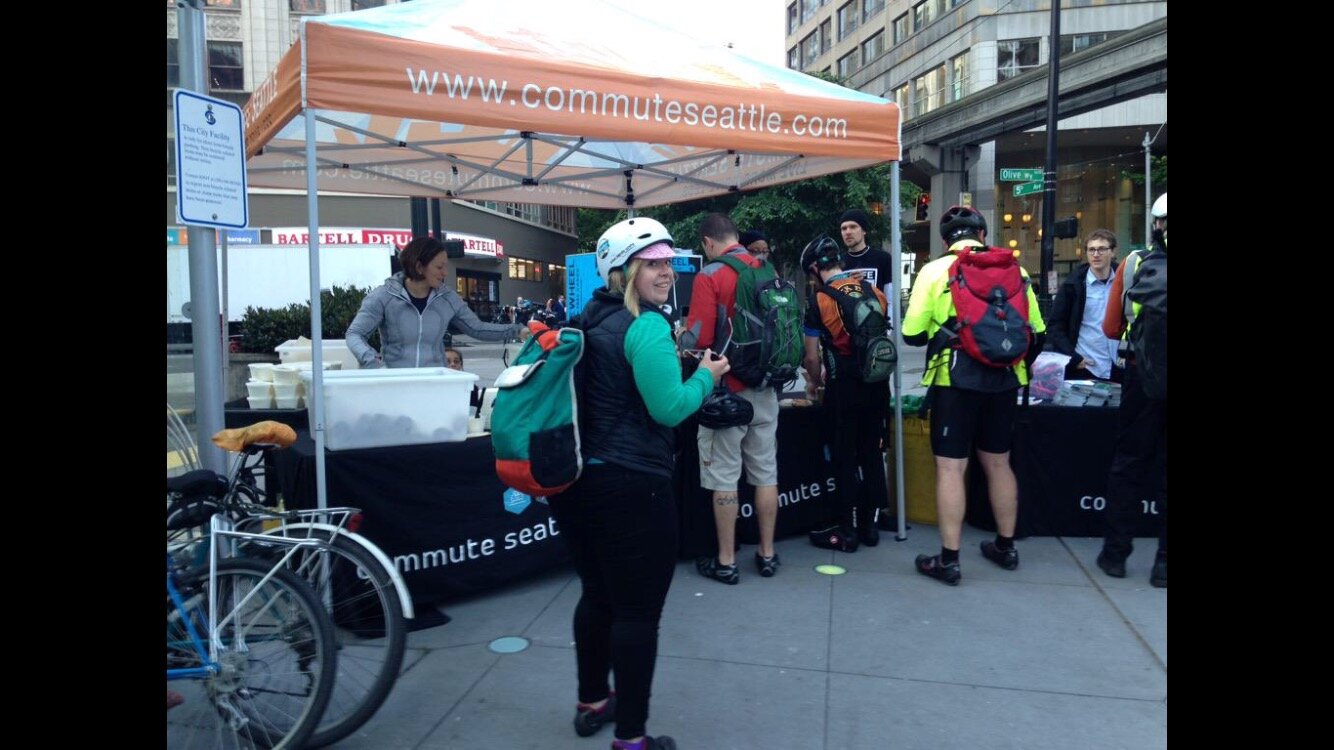
Marley in 2015

A blast from the past from Marley’s early days of commuting by bike.

I’m hoping by sharing my experience as a reluctant and admittedly often very lazy bike commuter, I can convince some of you to give it a try. And no, you don’t need to be in shape, wear anything special, or ride a fancy bike! Everyone can bike commute - even you!

Middle-aged workers, in particular, especially benefitted from active commuting. Walkers and bike commuters between the ages of 35 and 54 had better self-reported work performance in the study than their peers who were stuck behind the wheel or took public transportation.
— Bicycling Magazine

I started bike commuting a few years ago when I realized it was taking me 45 minutes to ride the bus 3 miles downhill (told you I was lazy.) I realized that I could get to work quicker on a bike, have fun in the process, and get my blood flowing - all definite wins in my book.

lock your bike

No matter how secure your building’s parking is, a strong lock is essential. At my work, people clearly left them there. Don’t do this. It’s obnoxious.

After lots of trial and error, here’s my best advice for a successful bike commute.

  • Prep the night before.

    Lay out your riding clothes, lights, shoes, gloves and jacket. Prepare your breakfast, pack your lunch and work bag, charge your lights. Whatever you need to do in the morning, do as much of it the night before as possible that way when your alarm goes off, all you need to do is get dressed, eat and hop on your bike! Trust me, it’s a lot harder to find your helmet at 6am than you might think.

  • Stash work shoes, toiletries, and a towel at work (if you can.)

    If you’re lucky enough to have a locker room or spot to change clothes at work, I highly recommend leaving as many of your toiletries (or getting a duplicate set) there as possible. No need to carry deodorant, a hair dryer and a towel back and forth every day! At my last company, we had a communal hair dryer and straightening iron for everyone to use, which was a total life saver.

    I also kept a stash of socks, underwear, a cardigan and shoes at work, because I would inevitably forget at least one of these crucial items most days. These lived in a desk drawer and saved my butt more than once.

  • Gear up properly.

    Not to be “that” person who says you need all the fancy gear, but there definitely is some gear you’re going to want for a comfortable commute- especially if you live in a place where it rains or is dark during your ride.

    The Bike: Any bike will work - honestly. For the most comfortable experience, I’d go towards a hybrid/all-road bicycle as they’re pretty dang durable. Something that can withstand potholes, rain, and lots of miles.

    If you’re lucky enough to live in a city with a bike share, that’s a great way to test out the waters of bike commuting! More on that in a future post.

    Electric bikes are another excellent option if they’re in your budget! Ranging from $999 for the RadMission to over $10,000 - the sky is the limit on how much you could spend on an e-bike (but you don’t have to!) Definitely a future post all about why I love e-bikes so much too!

    Rack & Panniers to carry your gear: Yes, you can use a backpack, but I like having my bike carry my stuff. My go-to is the Ortlieb Classic Backroll Panniers - they’re waterproof, durable and big enough to carry lots of stuff. If you want something a bit cuter, Po Campo makes great bags that transition seamlesslesly from the bike to the office.

As for racks, it’s hard to make a specific recommendation as you have to make sure it fits your bike. Chat with your local trusted bike shop and give them your business. If you don’t have anywhere to bolt on a rack, this rack that attaches to your seat post and seat stays is a cool option though. Do NOT use this if you have a carbon frame!!

  • Lights: Let’s face it, winter is coming. For those of us in the northern hemisphere, it’s likely we will be commuting in the dark. Being able to see (and being seen) is crucial for a safe commute. Pick a light that’s in your budget - honestly I’ve tried a bunch and they’re all pretty good. I highly recommend rechargeable lights - take them into your office during the day and charge them and you’ll never be out of juice!

    Fenders: Don’t be that person who sprays everyone behind you with gross water. Put fenders on your bike and keep yourself and those behind you dry. Bonus - it’ll keep your bike cleaner. (Make sure you get the proper size fenders for your tires!)

    Lock: No matter where you’re parking your bike (unless it’s literally at your desk), you need a strong lock. I recommend a U-lock that can secure your front wheel, especially if you have quick-release style wheels.

  • Do a Test Ride before you need to be at work on time!

    If you’re not already riding bikes on the regular, you might not have any concept of how long it’ll take you to get to work on your bike. This is ok!

    Do a test ride on the weekend to gauge how long the ride will take and how your body feels doing it. Make it super realistic by loading up your bags, putting them on your bike and riding with them! Nobody wants to be surprised by an extra complication when they’re in a rush. Also, keep in mind that traffic patterns might vary from the weekend to a weekday.

  • Be realistic about the mileage - consider making your commute multimodal.

    I realistically won’t ride more than 5-10 miles for a bike commute. And I ride a lot of miles when I want to. Be honest with yourself about how far you are willing to ride and use transit to help reduce the distance if you need. Most cities allow bikes to be loaded onto buses and trains.

    One idea - take transit to work and ride your bike home when there might be less of a time crunch.

  • Find a mentor or buddy to ride with.

    Ask around at work, in your local neighborhood Facebook group, or among your friends group. Perhaps there is an experienced rider who is traveling the same direction as you? Most cyclists are pretty friendly and excited to have more folks joining us on the road, so I’d encourage you to ask if they’d let you join on their commute. Having a seasoned rider lead you can help you gain confidence, learn tricks (or route tips) you might not otherwise know and provide extra visibility.

Bikes on the Train.jpeg

Bikes on the train

Don’t worry, this was pre-COVID.

Best of luck out there and more to come on this topic, including How to Bike Commute with a Laptop, How to Bike Commute and Not Get Sweaty, and How to Bike Commute in Dress Clothes!